
Criminal Court Cases in Cedar County
Cedar County Court handles misdemeanors, infractions, city ordinance violations, extraditions, and the preliminary stages of felony matters. A felony that proceeds is tried in District Court, part of Nebraska Judicial District 6. That split matters because a name may appear first in a County Court proceeding and later in a District Court file. Neither Hartington, Laurel, nor Randolph maintains a separate municipal-court database. Their ordinance and misdemeanor cases route through Cedar County Court.
The two clerks are separate custodians at 101 S Broadway in Hartington. The Cedar County Court office can be reached at 402-254-7441. The Clerk of District Court is on the second floor and can be reached at 402-254-6957. Both offices publish weekday hours of 8 a.m. to 5 p.m. and remain open through lunch. The clerks preserve docket entries, pleadings, orders, judgments, and other court-created records. Police narratives remain with the agency that wrote them.
The official County Court source shows the local court's jurisdiction and contact details. This image gives useful Cedar County criminal case context before a reader chooses a clerk.
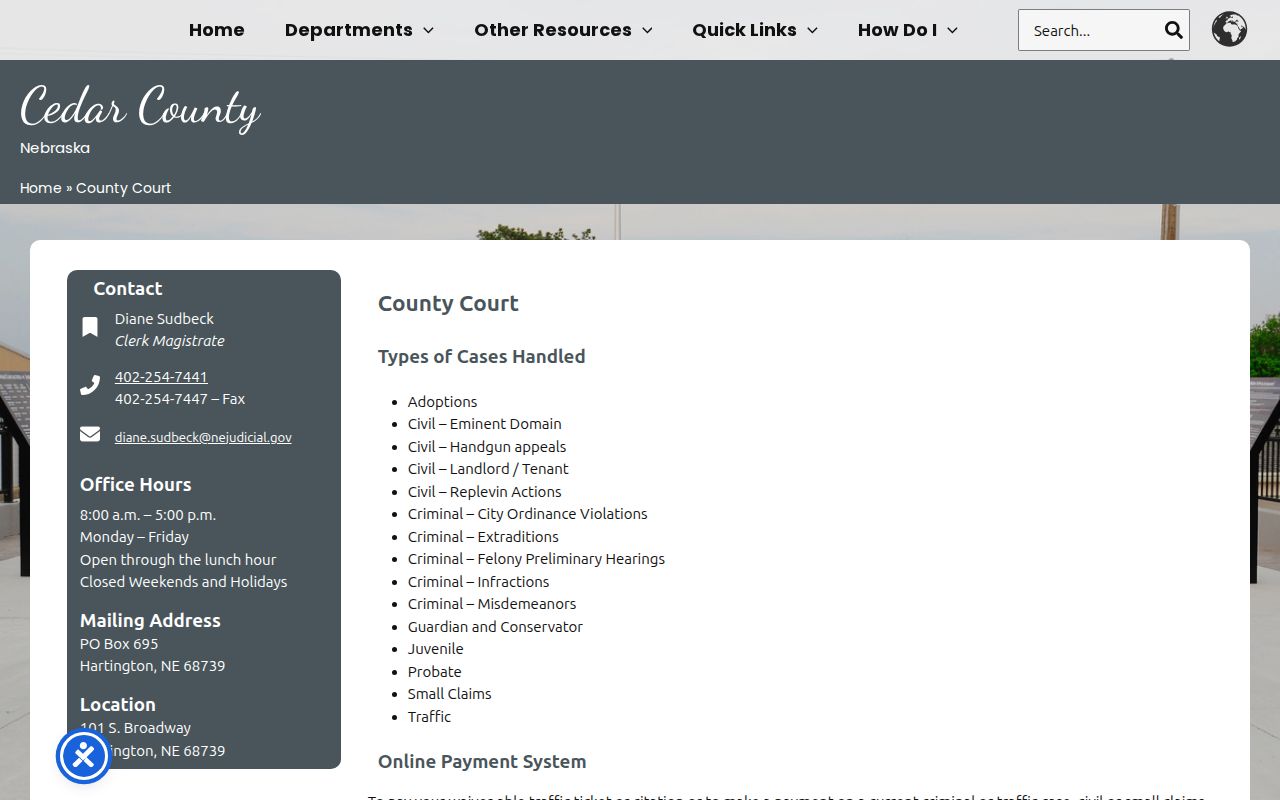
The office information helps distinguish the misdemeanor and preliminary-hearing counter from the District Court felony-record counter.
Cedar County Court or District Court?
Start with the alleged offense and the stage of the case. County Court is the likely first stop for a misdemeanor, infraction, ordinance matter, extradition, or felony preliminary hearing. District Court holds the prosecuted felony file after filing or bind-over. A complaint is a formal charging document. An information is a prosecutor-filed charge. A disposition is the outcome of a charge, such as conviction, acquittal, or dismissal.
A single incident can therefore produce more than one record trail. An arrest report may describe the officer's initial allegation. The County Attorney may file a different charge, amend it, or decline to proceed. The court file then records what actually happened in the prosecution. Readers tracing an outcome should follow the case number and final judgment, not assume that the booking label stayed unchanged.
Cedar County Court
101 S Broadway, Hartington, NE 68739
402-254-7441
Misdemeanors, ordinances, infractions, extraditions, and felony preliminaries.
District Court Clerk
101 S Broadway, second floor, Hartington, NE 68739
402-254-6957
Felony trials and district criminal files.
Cedar County Case Record Searches
JUSTICE, Nebraska's statewide trial-court case-management system, is the main remote channel. The One-Time Court Case Search costs $17, returns up to 30 party-name matches, keeps results available for three days, and does not include document images. Subscriber access costs $100 per year for up to ten usernames. General searches are free to subscribers, while opening detailed case information costs $2 and includes available images. A free courthouse terminal offers another route.
- Decide whether County Court or District Court should hold the Cedar County criminal case.
- Search JUSTICE by party name, or use a known court case number for a more exact result.
- Narrow subscriber results by court type, case type or subtype, Cedar County, year, judge, or attorney.
- Read the case summary and register of actions, then note the court, case number, charge, and disposition.
- Ask the correct clerk for a specifically identified document or certified copy when the online detail is not enough.
| Field Label | Type | Required | Notes |
|---|---|---|---|
| Party name | Text | Search choice | One-Time search uses a party name; subscriber search also accepts it. |
| Court type | Select | No | Use County Court or District Court to narrow results. |
| Case type/subtype | Select | No | Helps separate criminal matters from other case categories. |
| County and year | Select | No | Choose Cedar County and an estimated filing year. |
| Judge or attorney | Select/text | No | Subscriber criteria can refine a broad party-name result. |
| Court case number | Text | Separate search | Best identifier for a known Cedar County case. |
Note: A JUSTICE result is a court record, not the officer's complete incident narrative or the Cedar County Jail booking file.
Cedar County JUSTICE Access Choices
The Nebraska Judicial Branch's current fee announcement governs when older material conflicts. The online fees changed on January 1, 2026, the first such adjustment in more than a decade. One-Time access suits an occasional party-name search. Subscription access adds detailed case views and available document images. The courthouse terminal avoids the online access charge but still requires the reader to conduct a focused search.
The Judicial Branch's case-information access page lays out the choices shown here.
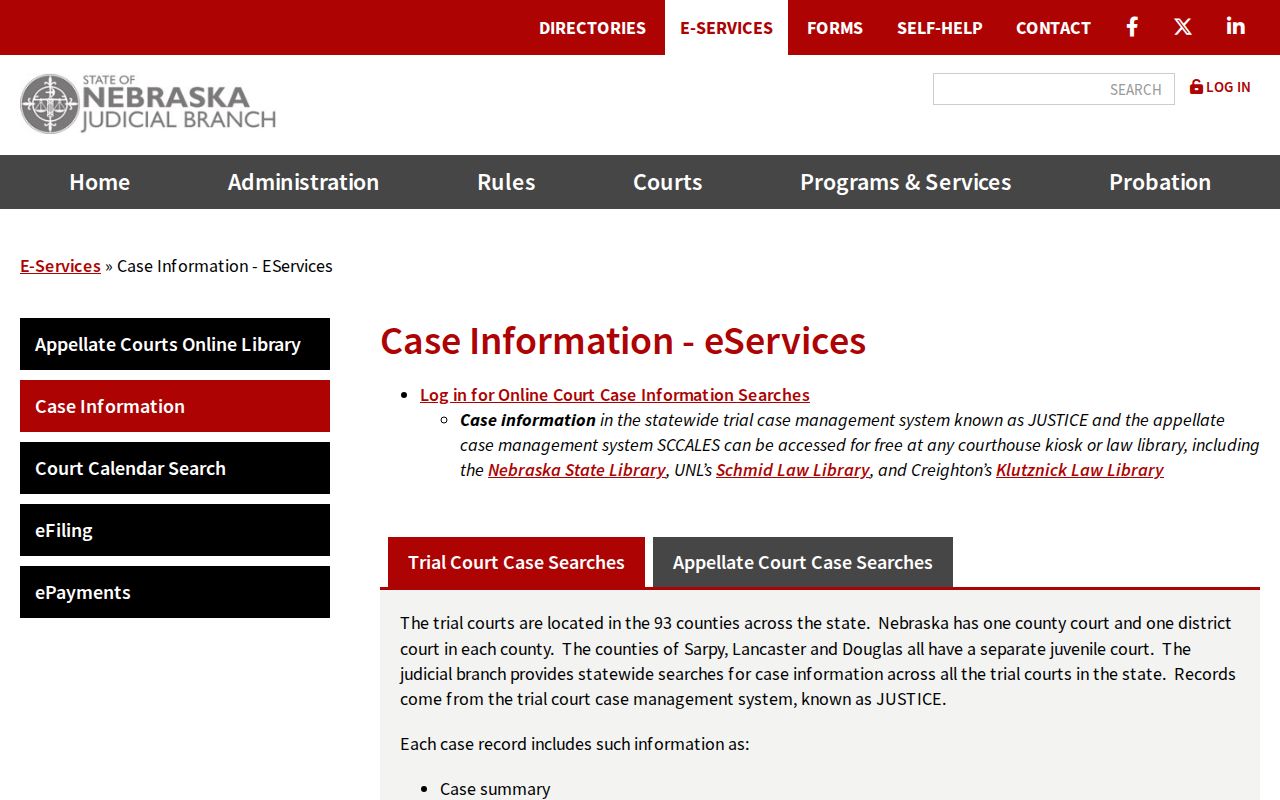
The three routes differ in price, detail, and convenience, so a case number found at the free terminal can also support a later focused copy request.
What a Criminal Case File Contains
JUSTICE organizes records by court case number rather than by an arrest cycle. Its official categories include a case summary, parties, offense information, assessed and paid financial entries, the register of actions, hearings, filed documents, orders, and judge notes when applicable. The detailed subscriber view can contain clickable document images. Availability may vary by case, and the research did not open a private paid sample, so no unverified field is promised.
| Case Number & Court | Identifies the file and whether Cedar County Court or District Court maintains it. |
|---|---|
| Charging Document | Shows the complaint or information and the offenses formally filed by the prosecutor. |
| Register of Actions | Chronological list of filings, hearings, orders, and other docket events. |
| Hearing Dates | Lists scheduled or completed court events as entered in the case system. |
| Disposition & Judgment | Records the result of charges, such as conviction, acquittal, or dismissal. |
| Sentence & Financials | Shows sentencing entries and available assessed or paid court financial data. |
The register of actions is an index-like chronology. It helps locate the filing or order that answers a question, but a short docket label may not state the whole substance of the document. Ask for that identified document when the label alone is unclear.
Cedar County Courthouse Kiosk
Nebraska's court records search policy provides for courthouse-terminal searching by party name or case number. The terminal is free. Court employees may direct a user to records and help locate a specifically described case, but staff do not conduct open-ended background research or issue a broad no-record certificate. Bring the complete party name, likely year, court level, and case type to keep the request focused.
The District Court Clerk's official page is a practical preview of the felony-record office.
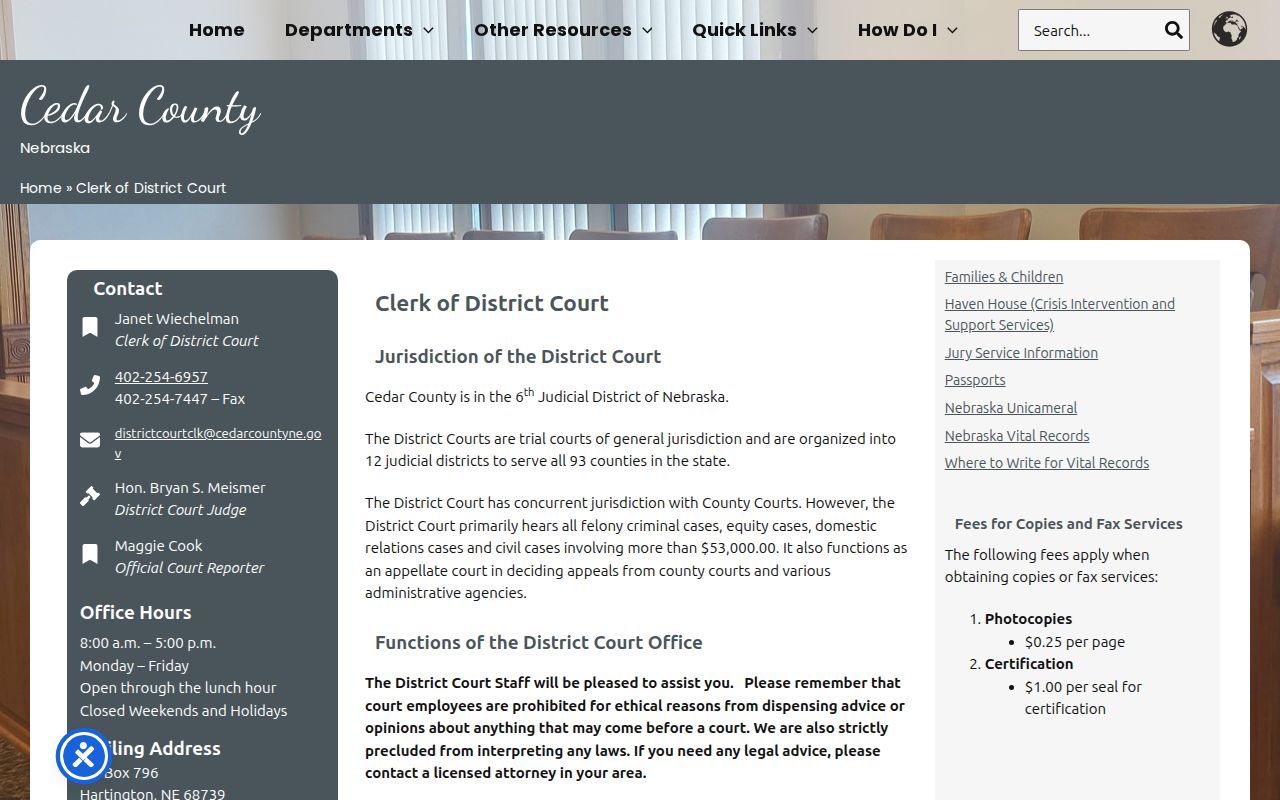
The screenshot connects the digital search route to the second-floor Cedar County counter that preserves pleadings, judgments, and older felony files.
Criminal Case Stages in Cedar County
A court case begins when the prosecutor files charges, not merely when an arrest occurs. County Court handles the early felony stage and takes pleas in matters within its jurisdiction. If a felony continues, the District Court file carries later pleadings, hearings, trial or plea activity, disposition, and sentencing. The time between events is case-specific, so no local duration should be inferred from the docket alone.
Case flow: Charges Filed › Arraignment › Pretrial › Plea or Trial › Disposition › Sentencing
A charge listed at filing is an allegation. A plea is the defendant's formal response. The disposition states how the charge ended. Sentencing follows a conviction and records the court-ordered consequence. Reading those entries in sequence prevents an early allegation from being mistaken for the final result.
Reading Cedar County Case Actions
JUSTICE's register of actions is the best starting point for the case timeline. Look for the charging event, arraignment, motions, hearing entries, plea or trial events, the disposition, and sentencing. An amended charge can replace an earlier version. A dismissal ends a charge without a guilty judgment, while an acquittal is a not-guilty determination. A set aside under Nebraska law can appear after sentence completion, but it does not erase every historical court entry.
- Arraignment
- The hearing where charges and rights are addressed and a plea is taken.
- Disposition
- The final or operative outcome of a charge or case.
- Register of actions
- The dated sequence of filings, hearings, and orders entered in JUSTICE.
- Set aside
- Nebraska relief that nullifies a qualifying conviction for specified purposes without making the whole file vanish.
A case can remain in JUSTICE even when an ordinary public NSP RAP sheet omits the related event under Nebraska dissemination rules. The products have different custodians, sources, and public-access limits.
Pre-1999 Cedar County Felony Files
Cedar County's District Court records instructions say online coverage begins in November 1999, while records in the office extend back to the 1880s. An older felony matter that does not appear online should be taken to the second-floor District Court Clerk. Supply a full name, approximate year, and case type. That archive route is a useful local exception to an online-only search.
District Court copies cost 25 cents per page, plus $1 for each certification seal. Certification is useful when an authenticated court copy is needed. Ask the clerk to confirm the exact file and page count before assuming the total. The clerk's jury instructions still refer to the second floor of the original courthouse, even though the complex gained an addition in 2009.
Note: A missing online result before November 1999 should lead to the Cedar County District Clerk, not a conclusion that no file exists.
Access Rules for Case Records
Nebraska's public-record law generally supports inspection and copying, subject to lawful exceptions and fees. Court access also follows Judicial Branch policy. Juvenile matters, sealed material, protected victim information, and other restricted data may not appear in a public online view. An absent result can reflect a name mismatch, wrong court, older archive date, restricted file, or no matching case.
Neb. Rev. Stat. §29-3523 controls public dissemination of specified criminal-history information, including certain no-charge, diversion, dismissal, acquittal, pardon, and set-aside events. It does not turn a RAP sheet into the complete Cedar County court docket. When a court entry appears wrong, obtain the case number and contact the clerk that supplied it. A person correcting a linked state history should start with the reporting court or agency, then work with the Nebraska State Patrol Criminal Identification Division.